

Why We Starve Artists
Workplace 2.0, Vol 1. Ed. 7: Transformation, Purpose and Profit

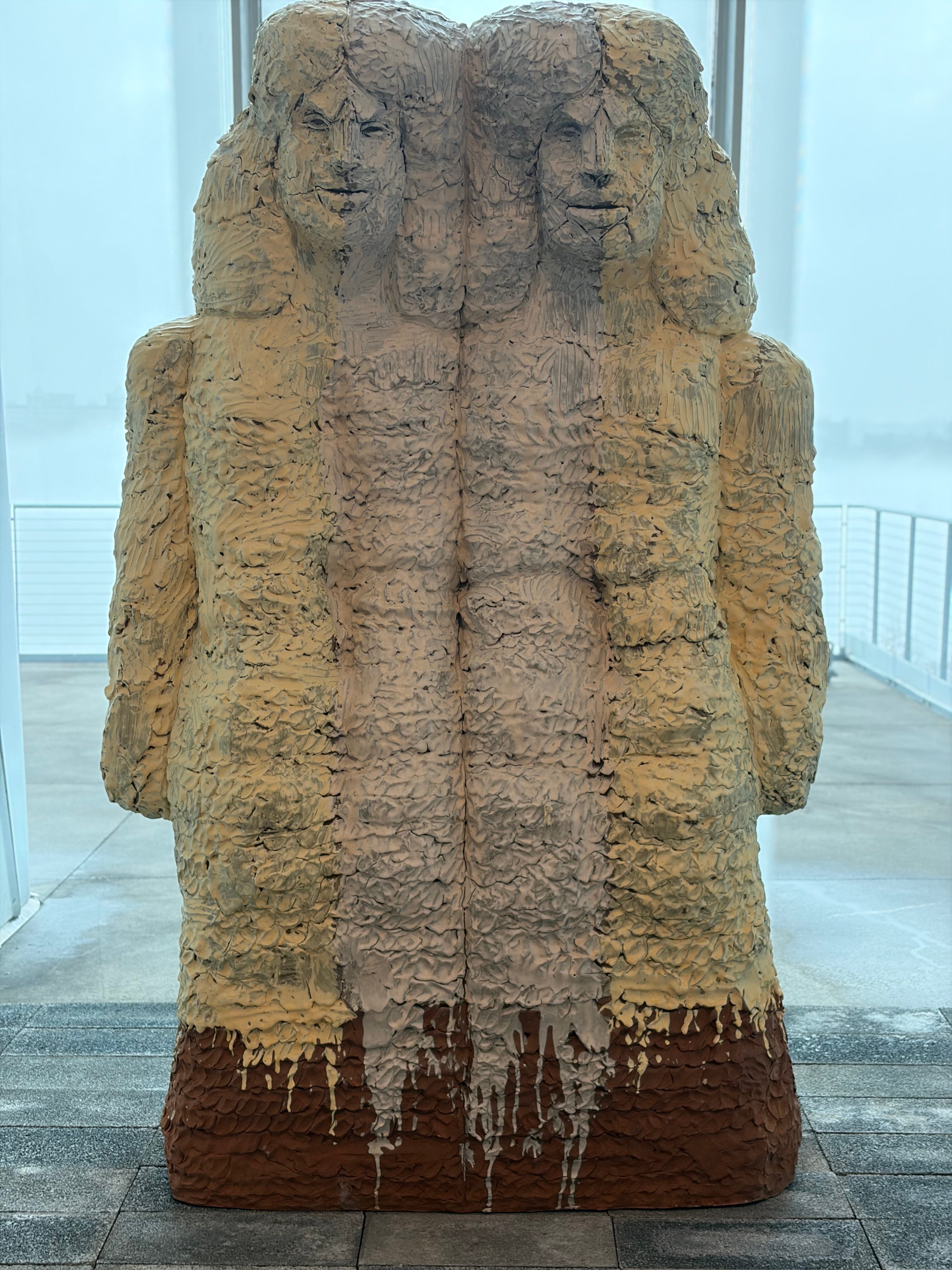
The twin figures reflect her sense that she never makes art as an individual, but always alongside others, including her family and ancestors.
Back during the pandemic, I decided to pursue a master’s certificate in religion at Harvard Extension. A certificate isn’t as big a commitment as a degree, and I could do it remotely. Check and check. It was an investment of both time and money, and the question I got most frequently from clients, family, and friends was: “Why?” “What are you ever going to do with that?” “How is this going to help your career?”
It’s funny how we’re constantly focused on outcomes. But I knew then, and believe even more so now: everything is religion.
Some people study religion to become more religious. That was not my intention. To me, the gift of studying religion is understanding the motivations of the world: Where does purpose come from? Why does it matter? Where do you find it?
Today, I bring this up to bookend my newsletter from Monday about dopamine capitalism. Before Adam Smith was known for economics, he was a moral philosopher. He was most influenced by David Hume—a philosopher considered so dangerous in his time that he was occasionally barred from universities. Hume didn’t believe in the rationality of God; he believed in the humanity of it.
This was the soil Smith grew in—a world where economics was a branch of moral philosophy, rooted in our innate “sympathy” for one another. To Smith, we weren’t just calculators; we were a collective. Standing before Raven Halfmoon’s piece at the Biennial on Sunday, I felt that same Smithian pulse. Her work isn’t an individual achievement; it’s an ancestral collaboration. It’s an exchange that values the soul of the maker as much as the clay itself.
But somewhere along the way, we deviated from that humanity, and I put that on Milton Friedman.
What we rail against when we see an infographic about capitalism ruining the world is not the concept of exchange itself, but the result of capitalism when manipulated by Post-War economists like Friedman. It’s not that the Robber Barons who built America didn’t damage capitalism through Social Darwinism; Andrew Carnegie literally wrote the Gospel of Wealth. But that philosophy eventually collapsed and was replaced by something considered much more “rational,” though equally damaging: the idea that “shareholder value is the only rational metric.”
The sterile “rationality” of it is what made it acceptable, as opposed to the outright cruelty of Social Darwinism. We traded the human soul for a spreadsheet.
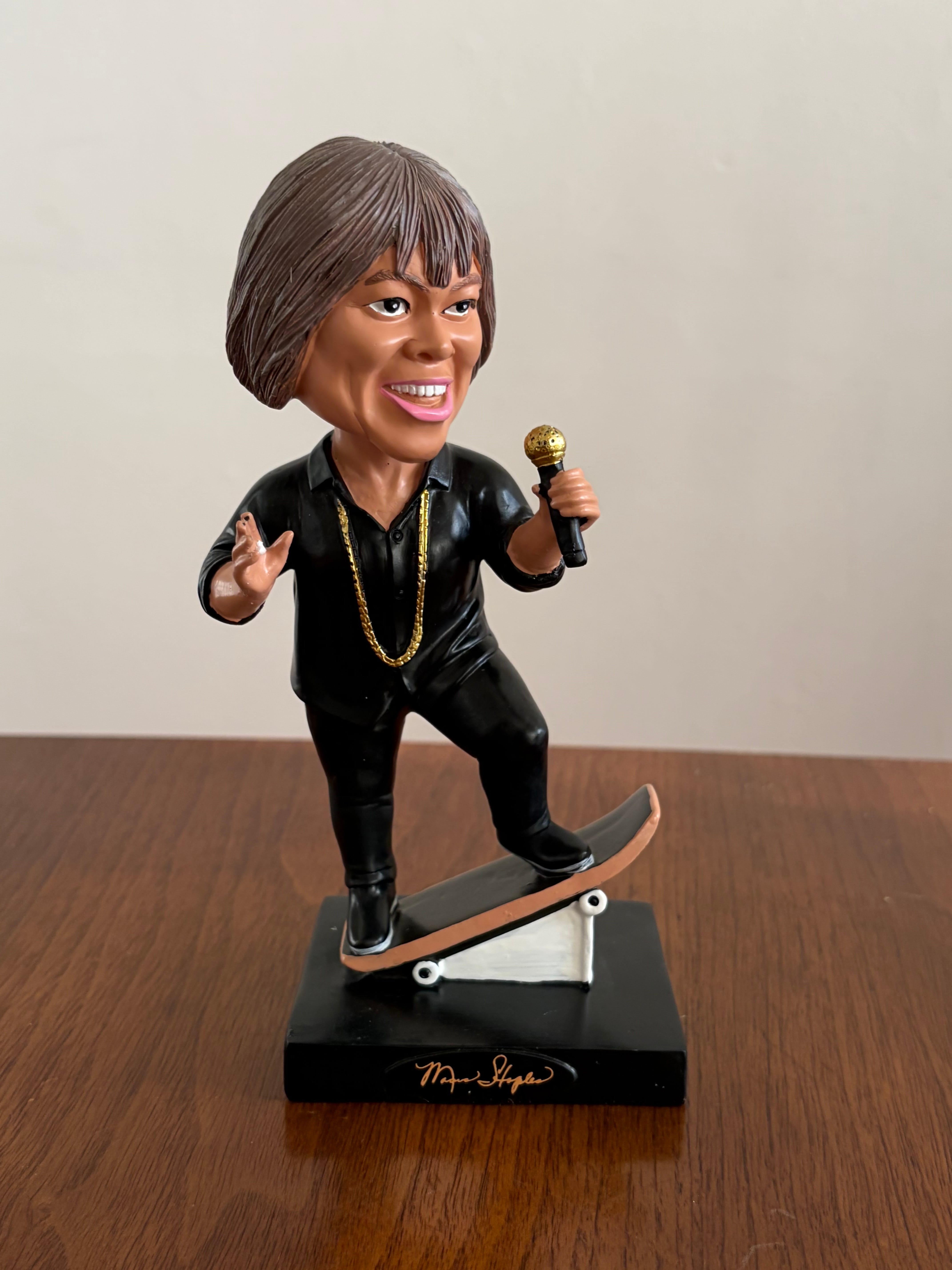
The week before the Biennial, I was at the Beacon Theatre to see Mavis Staples. Queen! One of the biggest surprises of the night was seeing my fellow music therapy colleague, Kyshona, opening for her. My heart literally exploded to see Kyshona’s trajectory over the last 20 years, from our days at Beth Abraham to the stage at the Beacon. It reminded me to stay the course.
Mavis herself was on fire. At 86, she took us there. For the last song, she conjured the spirits of all the Staples Singers and took us to that place of transformation. She has stayed the course.
I have thought a lot about that phrase, “I’ll take you there,” as it relates to modern capitalism. To engage in the exchange of goods and services for money isn’t actually rational. At its deepest, unconscious level, it is about transformation. How do you want to be changed? How does your customer want to be changed? It is why we choose, for better or worse, where our money goes.
We starve artists because we live in a society that puts supreme value on the “rational.” That is not the way Smith intended capitalism to be. The majority of the wounded men who run our societies determined that rationality was “safe.” It is as detached from feeling as they are from their own souls.
At the core of all of this—religion, art, and economics—is the question of Why? If we are to emerge economically viable, institutionally sound, and creatively cathartic, we have to have clarity on purpose. Purpose isn’t a “nice-to-have.” It is the catalyst for change. As my colleague Michael Bolognino recently wrote:

4. Remember why you work. It's rarely just the paycheck. When work feels like a trap, it's often because we've lost sight of what it's actually in service of. Reconnecting to your "why" is an act of resilience.
Workplace 2.0 is recognizing that purpose is the foundation of what “takes us there.” Artists starve because we think the economy is about objects and productivity, not about transformation and impact.
I think about Milton Friedman and his peers—men who lived through the terrifying instability of the mid-20th century. In that context, I can see why he clung to the “rational.” Efficiency and shareholder value are clean; they are measurable. They provide a sense of control in a world that felt dangerously out of hand. But that rationality was also a defense mechanism—a way to avoid the messy, unpredictable, and vulnerable reality of being human. By trying to make the economy “safe” from our feelings, we ended up stripping it of its soul.
Today, we find ourselves in a similar moment. The world feels out of control again, vibrating with that same post-war instability. But we have a choice that Friedman’s generation didn’t feel they could afford. We can choose to lean into the messiness.
We have to recognize that the answer to a world in flux isn’t more control—it’s more creation.
Control is an attempt to freeze the frame; it’s a preservation of a status quo that has already set the world on fire. Creation, however, is the only way through. It requires the same “Sun Twin” spirit Raven Halfmoon invokes: the recognition that we aren’t just producing objects for a market, but participating in a transformative, ancestral lineage.
If we are to emerge whole, we have to stop hiding behind the safety of the “rational.” It’s time to stop matching old patterns and start creating the ones that will actually take us there.
Stay the course! Take us there!
BOOK CLUB NEXT WEEK!
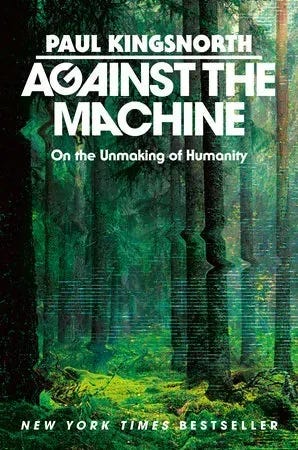
NEXT WEEK, we will meet via Zoom to discuss our first book: Against the Machine by Paul Kingsnorth. It’s dense but super thought-provoking. If you like Wendell Berry, this is your jam.
Location: Zoom
Date: Thursday, March 19th, 12 pm-1 pm ET - on the cusp of the Spring Equinox
RSVP: This is a free event; please email me to register. I will send out the Zoom link the week of the event.