Do you want my Nobel peace prize?
The Scheme, Vol. 1, Ed. 2: Leadership in the Era of Shenanigans

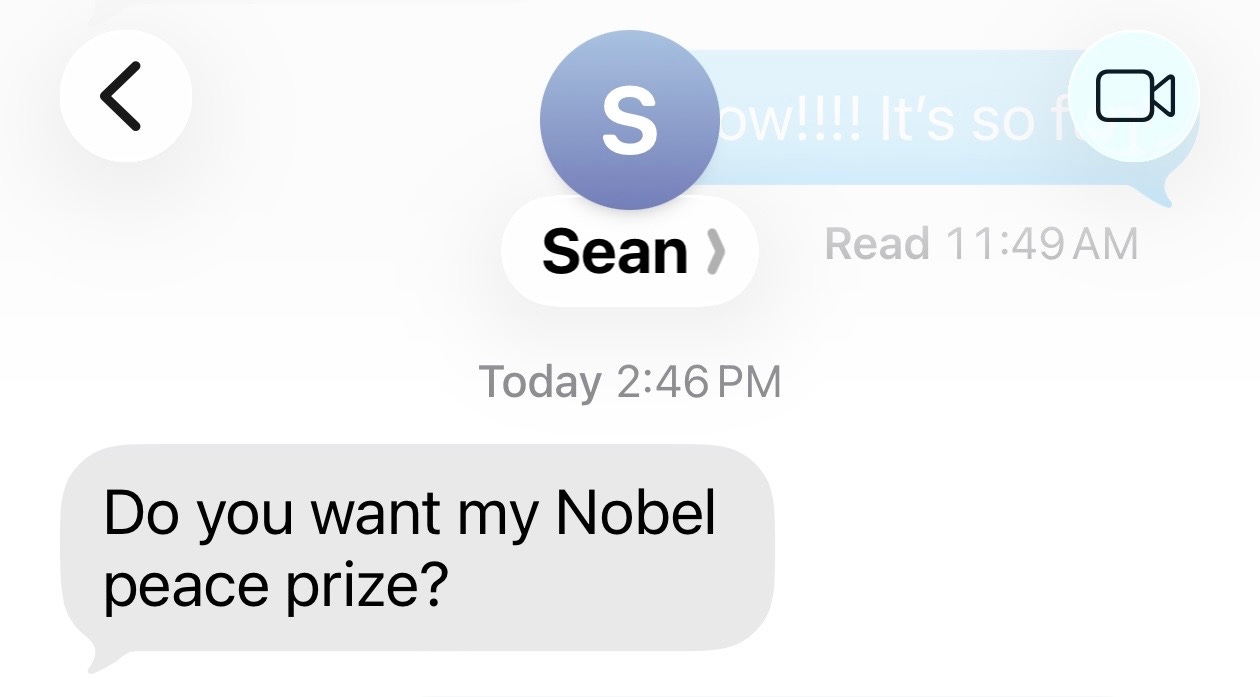
The text came in on Friday afternoon. It was my childhood bestie, Sean. Would I want his Nobel Peace Prize?
I was extremely flattered because I knew I obviously deserved it. Of course, I wanted it. I was seething with jealousy when he got it. Seething. But I played it cool. Sean and I have a long history. We met on the first day of high school at the bus stop. He was in his Chicago Bulls t-shirt, and I was likely in biker shorts (#slay).

It wasn’t quite grade school, but it was early enough in my life that Sean left a big impression on me. He was handsome. He was funny - the ultimate meme queen. He drove a chocolate brown Volvo. His abs were better than mine.
So I’ve always been susceptible to his shenanigans. But Sean's joke hit different this week because while he was texting me about fake Nobel Prizes, Muchado was actually, genuinely offering hers to Donald. Not as a joke. As a real gesture that she seemed to think was meaningful.
And that's when I read Adam Grant's piece in the New York Times about why we keep falling for narcissistic leaders.
The lower our opinions of ourselves, the more insecure we’re feeling, the higher our opinions of narcissists.
The piece highlighted something I've been watching play out everywhere, not just in politics, but in business, in startup culture, in the endless parade of charismatic founders who burn through teams and leave destruction in their wake. It also happens a lot in the “expert economy” too. Gurus offering certainty when the world is deeply uncertain.
Yesterday, on MLK day, my husband and I spent a lot of time talking about purpose. What is our (individual) purpose? What is the purpose of any of this? I said, if I think about what I care about the most, it is ultimately about calling bullshit. Truly. I think I have a skill, better than anyone I know, to detect a fake. And fake leaders are all around us. They are those start-up martyrs working 100-hour weeks to bring you the next sub-par technology. They are those charismatic social media personalities who know how to manipulate you through infographics.
As Adam Grant says, part of why we fall for them is because of how we feel about ourselves. But here’s the thing. The world needs more, not fewer, leaders. Just because we’re appalled by the leadership we see doesn’t abdicate our responsibility to provide ourselves, our families, our teams, and our communities with the leadership they need to change.
Fake leaders trade in vague promises and borrowed wisdom (and borrowed Nobel prizes). But the antidote isn’t cynicism, it’s self-awareness. It’s last week’s lesson about specificity. It’s knowing why you’re here. How you want to behave and what you’re creating in the absence of external validation. It is the opportunity to know yourself more clearly and deeply. The clearer you are about yourself, the less you need a narcissist to tell you who to be.